Mental ROI: balancing high technological productivity (IA) with Human sustainability
It’s not all about money and short- and medium-term (less than 18 months) profitability, but also about preserving sustainable, long-term organizational cognitive capital.
entation.» If an employee jumps between 15 applications and has 30-minute meetings without a break, their cognitive load is unsustainable.

How to measure «Mental ROI» in companies: Cognitive Load and Mental Efficiency Indicators.
Does an employee feel ENERGIZED for their personal life or empty after completing an AI-assisted project?
AI Metrics for Mental ROI: Cognitive Load Index
AI can measure «work fragm
Multitasking is largely a myth: the human brain doesn’t perform complex tasks simultaneously, but rather switches rapidly between them, which generates a high cognitive cost, mental fatigue, lower productivity, and increased stress. This constant habit can reduce brain density in areas of cognitive control and affect memory.
KPI: Reduction of task fragmentation vs. Increase in the quality of deliverables.
Dashboard: Mental ROI in the Digital Age
Traditional Metrics | AI-Powered Metrics | Business Value |
Climate Survey | Real-time Pulse Checks | Instant feedback on company changes. |
| Absenteeism | Predictive Attrition Model | Identifies who has «mental fatigue» before they request sick leave. |
| Overtime | Digital Wellness Score | Measures if work occurs outside of working hours (right to disconnect). |
Healthcare Cost | Biometric Data ROI | Optional integration with wearables to measure sleep quality/stress. |
Ethics: The Limits of AI: In a large corporation, AI-powered mental ROI only works if trust exists.
Transparency: Employees must know what data is being measured and for what purpose.
Anonymity: AI should aggregate data (e.g., «the Marketing team is at risk of stress») and never single out individuals, unless it’s on a private health platform.
Mental ROI = (Value Produced + Remaining Energy)\ (Cognitive Load Invested + Stress Generated)
- Mental ROI > 1,
- Key Benefits:
- Reduced Absenteeism: Fewer sick days taken due to improved mental health.
- Lower Turnover: Higher employee retention rates, which reduces hiring costs.
- Higher Productivity: Increased engagement and performance.
- Lower Health Care Costs: Reduced expenses for high-cost medical claims.
- Cost Avoidance: Effective programs prevent future high-cost claims or disability leaves, providing long-term cost containment
- Key Benefits:

From a Human Resources perspective in a large corporation, mental ROI (Return on Investment) refers to the balance between the cognitive, emotional, and psychological effort an employee invests in adopting AI versus the perceived benefits (productivity, well-being, purpose).
If the cost of adaptation consistently outweighs the reward, we enter a negative mental ROI. In the long run, this is not just a morale issue, but a critical operational risk.
Examples:
1. The Phenomenon of «Devaluation of Self-Value»
The most subtle but devastating risk is that the employee feels their human judgment has been sidelined.
- Risk: If AI makes the «interesting» decisions and the human only monitors data, professional identity is eroded.
- Consequence: Emotional disconnection and loss of expert intuition, leaving the employee unsure how to react to a system failure.
2. Fatigue due to Permanent Adaptation
In large corporations, AI tools change every few months.
- Risk: The human brain isn’t designed to live in a state of constant relearning without periods of consolidation.
- Consequence: Technological burnout. Staff begin to passively-aggressively resist new implementations, not because they don’t work, but because they no longer have the mental capacity to learn yet another interface.
3. The Paradox of Productivity and the Time Vacuum
When AI saves two hours of work, HR often makes the mistake of filling those two hours with more administrative tasks.
- Risk: Employees perceive the technology as simply exploiting them, not improving their work.
- Consequence: If the perceived ROI is negative, employees will use AI to «appear» to be working while their actual engagement drops to zero (digital quiet quitting).
Risk Matrix of Negative Mental ROI
| Area | Long-Term Impact |
| Talent | Brain drain of the most creative profiles (who are the ones who suffer the most from the automation of cognitive tasks). |
| Culture | Climate of distrust and fear of replacement, which blocks collaboration. |
| Innovation | Reduction of critical thinking; employees become dependent on AI output. |
| Mental Health | Increase in leave due to stress and anxiety derived from the pressure for immediacy. |
¿How can HR mitigate this?
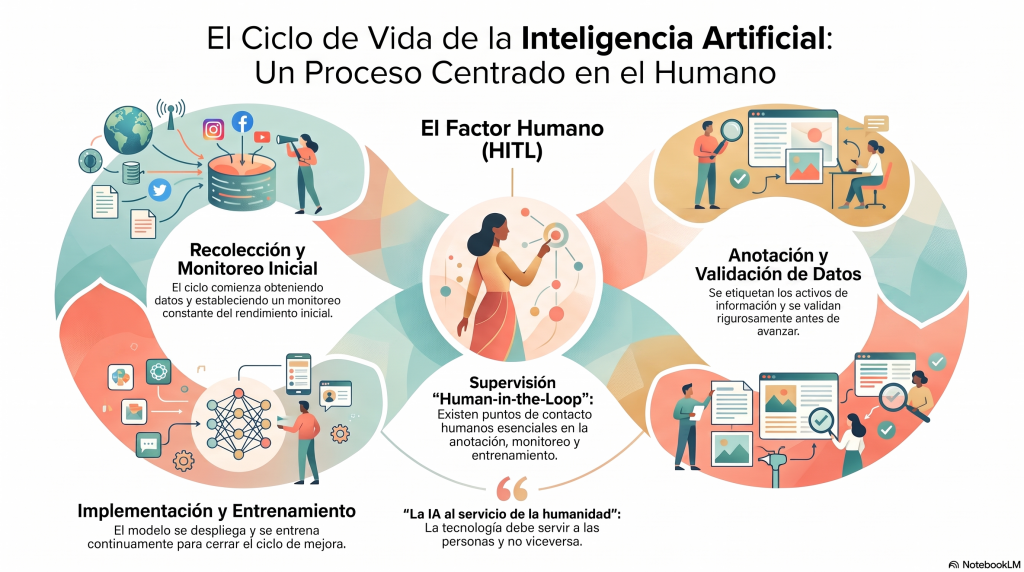
For a positive mental ROI, AI implementation must be designed around the concept of Human-in-the-loop:
- Redesigning Roles, Not Just Tasks: It’s not enough to simply put AI in an old position; we need to define what new human capabilities (empathy, strategy, ethics) that employee will now enhance.
- Agency Literacy: Ensure that the employee feels they have ultimate control. AI should be the «copilot,» not the «captain.»
- Compensating for Cognitive Effort: Recognize that learning to use AI is a task in itself and provide «technological quiet spaces» to prevent saturation.
- Implement workshops with Mentors on the importance of Human Talent and how to manage our Prefrontal Brain and Emotions through Mindfulness Techniques.
In summary: If your AI strategy saves money (financial ROI) but depletes the psychological capital of your people (mental ROI), your company will be efficient in the short term, but fragile and soulless in the long term.